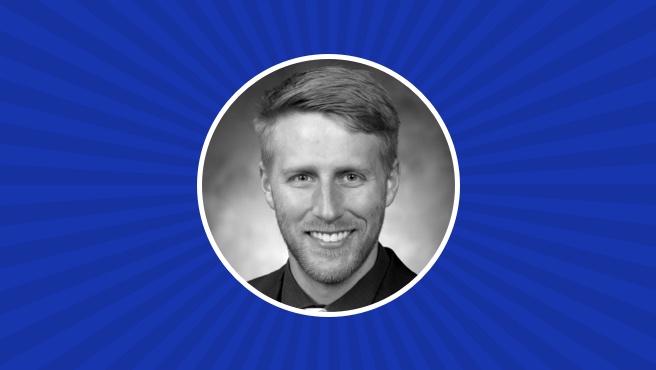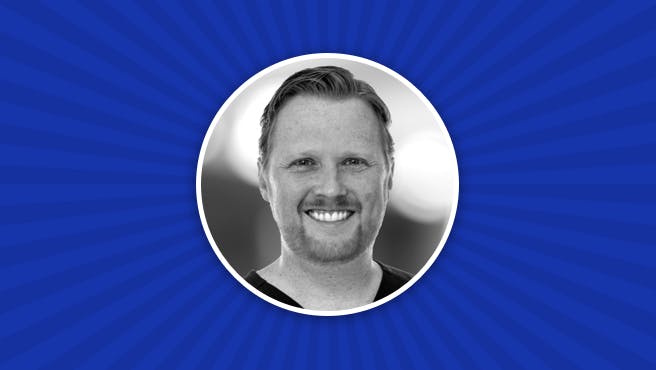



Dr. Mueller is a cataract and refractive surgery specialist. In 2024, he founded Mueller Vision LASIK & Cataract Eye Surgery in Fort Worth, Texas.
1. Please share with us your background.
I am a sixth-generation Texan, born and raised in San Antonio. I come from a large Catholic family with four sisters and one brother, and I am right in the middle.
I attended college at Texas A&M University, and that is where I met my amazing wife, Deanna. We both went to the University of North Texas Health Science Center in Fort Worth, Texas, where she attended a physician assistant program and I obtained a combined DO-PhD. During my 7 years in this program, I studied neuroprotective properties of retinal ganglion cells (RGCs), looking for a neuroprotective target for the treatment of glaucoma. I then completed ophthalmology residency at the University of Louisville in Louisville, Kentucky. During my residency, Deanna and I had two beautiful boys. It was tough to learn how to be an eye surgeon and a father at the same time. To make it even more interesting, my second son was born prematurely at 33 weeks. I remember being a second-year ophthalmology resident, spending my days at work and nights in the NICU with my newborn son. Residency was an incredible and challenging experience, but I have wonderful memories of my time in Louisville. It is a special place with some amazing people, and I feel blessed to have received my training there. During residency, I thought that I was going to become a glaucoma specialist—I had, after all, obtained a PhD studying glaucoma! I applied for glaucoma fellowship and went on some interviews. However, after some soul searching, I realized that my true passion in ophthalmology was cataract and refractive surgery.
When I graduated residency, I joined a comprehensive ophthalmology practice with hopes of gaining refractive surgery experience. However, I quickly realized that would not be the case. I found it unsettling to offer patients premium lenses because I knew that, if I did not hit my target, I did not have the adequate training to perform a corneal refractive procedure to help my patients across the finish line in terms of their desired outcome. Realizing the significant gap in my training and wanting more refractive surgery experience, I joined Greg Parkhurst, MD, at Parkhurst NuVision in San Antonio as his first refractive and cataract fellow through the Refractive Surgery Alliance (RSA) Fellowship Network and World College of Refractive Surgery and Visual Sciences. At this point, we had just had our third child (a girl this time) and were drowning in kids, with three under 4 years old. Deanna encouraged me to pursue fellowship, but she wanted to be at home with the kids. With some solid financial planning, we became a family of five living off of a fellowship salary.
During my fellowship year at Parkhurst NuVision, I performed more than 3,000 surgical procedures and learned how to be a world-class refractive surgeon. I stayed on at Parkhurst NuVision for 2 more years as an associate, which allowed me to gain a ton of refractive and cataract experience. In 2022, I had the opportunity to join Alliance Vision Institute in Fort Worth as an associate.
2. What drew you to ophthalmology and, specifically, to your field of interest?
When I started medical school, I thought I would study neurology. I had a strong passion for the neurosciences and was fascinated by the unknown aspects of the brain. In my dual-degree program, I joined the Department of Neuroscience and Pharmacology to find a cure for Alzheimer disease. As I began my laboratory rotations, I met the man who would eventually become my research mentor, Thomas Yorio, PhD, and he told me about his research on neurons in the back of the eye. His lab was studying neuroprotective targets in RGCs in hopes of developing a neuroprotective agent to treat glaucoma. At this point, I had started working on my PhD, I had only completed my second year of medical school, and I had no clinical exposure to ophthalmology.
Before I even developed a clinical passion for ophthalmology, I was enthralled by the science of the eye. From the first day of my research project, I was captivated by the physiology and pharmacology of RGCs. As I investigated modulations of calcium signaling, induction of neural protective pathways, enhancement of synaptic plasticity in the form of dendritic spine outgrowth, and mitochondrial movement and transport in primary RGCs, I was fascinated by the complexity and beauty of the visual sciences. While working on my PhD, I began spending time in an ophthalmology clinic, and it was then that I realized how much I enjoyed the clinical and surgical aspects of the specialty.
As a resident, I thought my strong scientific background would make glaucoma a good fit. However, I eventually realized that, although I love the scientific aspect of glaucoma, I did not enjoy the surgical or clinical aspect of the subspecialty. At the same time, I became enthralled with cataract and refractive surgery. Being able to improve patients’ vision and give them a life free from glasses and contacts became a huge passion of mine. It is crazy to think that half of the global population is affected by cataracts, refractive error, or presbyopia—there is still so much work that needs to be done in these areas.
However, like most residents, I graduated from residency with a lot of cataract surgery experience but very little refractive surgery experience. This led me to join the RSA, through which I met Guy Kezirian, MD, a connection that changed the trajectory of my career. Dr. Kezirian took me under his wing and has been my mentor and guide ever since. He opened my eyes to the work being done in the realm of refractive surgery all over the world through the RSA and soon-to-be-formed World College of Refractive Surgery and Visual Sciences. Dr. Kezirian also helped me find a fellowship mentor, Dr. Parkhurst, in my hometown of San Antonio. From that moment, I was hooked and realized that I wanted to be one of the top refractive surgeons in the world.
3. Please describe your current position.
Currently, I wear two hats. First, I am a refractive, cataract, and anterior segment surgeon at Alliance Vision Institute. I work with Taylor Strange, DO, who started the practice in 2017. His experience shows that, even in this day and age, it is possible to hang your shingle and be very successful. All it takes is some courage, self-confidence, good leadership skills, and a helping hand from others.
Second, I am an Associate Academic Director for the RSA Fellowship Network, a network of more than 20 refractive surgery fellows from all over the world who gather twice a month to learn about refractive surgery. In this role, I have the absolute pleasure of working with Helen Wu, MD; Radhika Rampat, MD; and Dr. Kezirian on a weekly basis to develop a formal curriculum and ultimately change the paradigm of how refractive surgery is taught. I collaborate regularly with some of the best-trained refraction surgeons around the world, and it’s been enlightening to have this international perspective at my fingertips. I cannot wait to see how much this program grows over the next 5 to 10 years.
4. Who are your mentors?
We stand on the shoulders of giants, and it’s important for everyone to have mentorship in their lives. I would not be here today without the amazing people with whom I have had the opportunity to work.
First and foremost, the most influential ophthalmologist to my career is Dr. Parkhurst. He taught me what it takes to be a world-class refractive and cataract surgeon. He also taught me from a business standpoint how to run and operate a world-class refractive surgery practice. Completing a fellowship with him and spending an additional 2 years working by his side was one of the most influential experiences of my professional life and put me in position to reach my career goals.
Another influential mentor of mine is Dr. Kezirian. He is an example of what can be accomplished by not letting anything hold us down. I call him the godfather of refractive surgery because, if something is related to refractive surgery, chances are Guy has been involved in its development. I feel fortunate to have him in my corner as a mentor and good friend.
Next, I would not be here today if it were not for my outstanding residency mentors and attendings in Louisville. They provided me with a well-rounded education and laid the groundwork for me to be the ophthalmologist I am today.
Last, let’s not downplay the difficulty that we younger ophthalmologists face. It can be challenging to be a refractive and cataract surgeon today. Patient expectations are through the roof, and the job landscape is challenging. Good opportunities are hard to find, and private equity has altered the field and hurt future buy-in opportunities for the next generation of ophthalmologists. I am still trying to figure out how all of this will play out in my own career, but by my side are some of my closest friends, peers, and colleagues: Neda Nikpoor, MD; Brian Shafer, MD; Morgan Micheletti, MD; Dagny Zhu, MD; Arjan Hura, MD; Nandini Venkateswaran, MD; Cristos Ifantides, MD; Krishna Surapaneni, MD; Caroline Watson, MD; Jorawer Singh, MD; Ranna Jaraha; my refractive surgery fellows; my Physician CEO classmates; and many more!
5. What has been the most memorable experience of your career thus far?
Being a refractive and cataract surgeon provides many memorable experiences. The ability to change lives by giving people clear vision is so rewarding. However, one of the most memorable experiences of my career was when I traveled to Mexico for a surgical mission to remove cataracts for people without access to health care. The days were long, and the easiest case was a 20/200 cataract, but it was gratifying to be a part of such an important mission. Being able to focus exclusively on helping people felt incredible—like being able to practice medicine in its purest form.
6. What are some new technological advances that you have found particularly exciting? Which advances in the pipeline are you most enthusiastic or curious about?
I am excited about high-frequency digital ultrasound technology that enables us to take precise measurements of the cornea and internal structures of the eye. This will enable better refractive surgical planning, calculations, and improved results for patients. I am also excited about the future of ray tracing and the ability to create a true avatar of the eye, which can be used with AI to develop LASIK treatment plans that can correct the full optical system.
7. What is the focus of some of your research?
I have an interest in and passion for all things involving refractive and cataract surgery. I am currently completing an investigator-initiated trial for which I performed a prospective study of patients with prior myopic LASIK or PRK who received a trifocal PanOptix IOL (Alcon). I have also performed research on nomograms for ICL sizing using ultrasound measurements.
8. What is a typical day in your life? What keeps you busy, fulfilled, and passionate?
Being an ophthalmologist, husband, father, researcher, educator, and lecturer keeps my plate full. Excelling in all facets of my life while maintaining a balance is a daily challenge, but it’s a challenge that I love.
I typically wake up around 5 AM and start my day with a run (my goal is to run a marathon this year). I then eat breakfast, chat with my kids before they leave for school, and get ready for work. My workday typically starts around 8 AM and ends at 5 PM. I currently spend 3.5 days in clinic, a half-day in the OR, a half day in the LASIK suite, and another half-day on practice development. As my practice grows and my surgical volume increases, I envision spending 2 full days in the OR, 2.5 days in clinic, and another half-day performing LASIK.
When I return home at the end of the day, I am usually greeted at the door by my three kids running toward me with open arms yelling, “Daddy!” I also just signed up to be the head soccer coach for my 6- and 8-year-old sons’ soccer team (let’s go, Wolf Pack!). We then eat dinner, play games, do homework, and get everyone ready for bed by 9 PM. After that is usually my time to relax, do work, or complete any unfinished projects.
The most important things in my life by far are family and friends. I am not a believer in attaining happiness through material possessions. I believe that people and life experiences are where true fulfillment comes from. I am blessed and fortunate to have an amazing wife and three beautiful kids. In addition, I also have a robust network of like-minded colleagues and friends, and the ability to interact with these people daily gives me true happiness and fulfillment.
9. What advice can you offer to individuals who are just now choosing their career paths after finishing residency or fellowship?
I always thought that completing residency and fellowship would feel like reaching the finish line, but, in fact, it felt like I had not even started the race. This life journey is a marathon with many ups and downs. You will need to lean on others during the down times, and you will need to help others during your up times. It’s important to have a strong network of people you can turn to and trust. No one has it figured out, and, if it seems like they do, they are probably pretending.
After residency or fellowship, spend time figuring out who you really are. What is your life mission statement? What are your core values? What do you stand for? What makes you happy? What are your career goals? When you are done training, you no longer need to worry about making an attending happy—you just need to make yourself happy. If you find yourself in a situation where you are not happy, do not be afraid to make a change or pivot. This is the only life we have, so we might as well spend it doing what we want to do.
10. Tell us about an innovative procedure you are performing or a new imaging/diagnostic tool that has improved your practice.
One procedure that I love performing above all others is the implantation of the EVO ICL (STAAR Surgical). I am interested in trying to help determine the best ICL sizing parameters and am therefore excited to have recently obtained an ArcScan Insight 100 (ArcScan), a device that provides high-definition ultrasound images of the internal structures of the eye. By using this technology and the ICL sizing nomogram developed by Dan Z. Reinstein, MD, MA(Cantab), FRCSC, DABO, FRCOphth, FEBO, we can accurately predict the ICL vault size preoperatively for each patient.