


Please share with us your background.
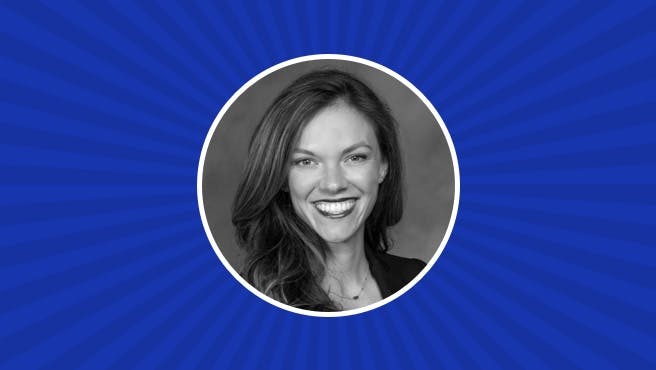
I grew up in Jackson, Mississippi. My dad is a civil engineer, and my mom stayed at home with me and my sister. I followed in my dad’s footsteps and graduated with a biomedical engineering degree from Mississippi State University. Upon graduation, I moved to Charlottesville, Virginia, to work in a biomechanics lab at the University of Virginia while I considered applying to medical school. During this year, I lived with a host family—the Uthlauts. Dr. Uthlaut happened to be the program director for the internal medicine residency at the university. With his encouragement and guidance, I realized that medicine was the right choice for me.
The following year, I returned to my hometown and started medical school at the University of Mississippi Medical Center (UMMC). I married my medical school classmate, Daniel Duddleston, and we couples-matched in ophthalmology and internal medicine at the University of North Carolina at Chapel Hill. We loved our time in North Carolina, but when my husband began considering cardiology fellowships, we decided to move closer to family. Daniel matched at the University of Alabama at Birmingham for cardiology, and I accepted a job as a comprehensive ophthalmologist nearby. We now have a 1-year-old daughter and are thankful to live within driving distance of family.
What drew you to ophthalmology and, specifically, to your field of interest?
Because of my engineering background, I was drawn to the field of ophthalmology with its rapidly advancing technology for both the clinic and the OR. During one of my away rotations at the University of Alabama at Birmingham, I worked alongside Ahmed A. Sallam, MD, PhD, on a project involving the optics of the three-dimensional display system. I loved collaborating with industry and working alongside Dr. Sallam, who truly exhibited a passion for teaching and research. There were countless times we would meet between OR cases to sit and discuss different research topics, and residents and fellows would all join in on the discussion.
Two years into my practice, I am so thankful to love what I do. My favorite part is seeing my postoperative patients smile, happy they can now clearly see their grandchildren’s faces or more easily read their favorite novels. My career brings me satisfaction and encouragement, which means even more to me now that I have a daughter. It would be that much harder to leave her at daycare if I didn’t have a fulfilling career.
Please describe your current position.
I am a comprehensive ophthalmologist at Alabama Vision Center in Birmingham, Alabama, which is under the umbrella of the private equity group EyeCare Partners. I took over a patient base from a retiring ophthalmologist/cornea specialist in the area whose practice consisted of comanaged cataracts as well as LASIK, PRK, and refractive lens exchange. One of the reasons I chose this position was because of the opportunity to add another tool to my toolbelt. Before my predecessor officially retired, he taught me how to perform LASIK and PRK. The practice has grown over the past few years, and we now have four ophthalmologists and three optometrists. I have been with the practice for a little more than 2 years, and I look forward to years to come.
Who are your mentors?
During my medical training and career, I have been encouraged and motivated by many inspiring role models along the way. I will mention a few of them here.
During my time at UMMC, Kimbery Crowder, MD, the ophthalmology residency program director at the time, was a huge role model for me. She is an excellent example of a female powerhouse in ophthalmology, and I yearned to follow her lead. While working with her, I had the incredible opportunity to present a morbidity and mortality case to the vice chancellor of the UMMC medical school on behalf of the ophthalmology department.
During my ophthalmology training at the University of North Carolina, I learned cataract surgery from Kenneth Cohen, MD, my original cataract coach. He dedicated his entire career to teaching cataract surgery to residents and had a wealth of knowledge and resources to guide me as I carefully made my first capsulorhexis or tied my first corneal suture. His teaching helped me form a strong foundation for my surgical career within ophthalmology.
In my current practice, one of my partners, Andrew Bartlett, MD, FAAO, has been a tremendous point person for all my questions. He has provided a wealth of knowledge on topics from how to deal with difficult patients to how to handle planning for an IOL exchange.
As I think back on the mentors who have invested in me, I look forward to investing in others and helping them bridge the gaps to their bright futures ahead.
What has been the most memorable experience of your career thus far?
My career is still young, as I am two years out of training. I did, however, enjoy my time at ASCRS as a trainee. Thanks to YoungMD Connect (YMDC), I rubbed shoulders with leaders in surgery and industry, and the meeting left me feeling excited about the potential for my future career.
What are some new technological advances that you have found particularly exciting? Which advances in the pipeline are you most enthusiastic or curious about?
I am currently very interested in the Light Adjustable Lens (RxSight). This exciting new technology is ideal for post-LASIK/PRK patients as well as monovision patients. Even with advancing formulas such as the Barrett True K, we sometimes still miss the mark; it’s nice to avoid having to take the patient back to the OR for a lens exchange.
What is the focus of some of your research?
I am not currently involved in any research projects as I am focusing on my early career and my family. I look forward to returning to the research world, particularly within the field of optics and refractive outcomes.
During medical school and residency, I conducted research in many areas of ophthalmology, including glaucoma, pediatrics, and plastics. I considered a fellowship in each of these subspecialties; however, I have since found comprehensive ophthalmology to be the perfect place for me. I love performing cataract surgery and routine eye exams because they allow me to develop relationships with my patients. I am happy with my current career as a comprehensive ophthalmologist focusing on cataract and refractive procedures, and I look forward to finding a way to implement research and partner with industry in the near future.
What is a typical day in your life? What keeps you busy, fulfilled, and passionate?
I split my clinic time between three offices and I operate 1 day per week on average. I like this breakdown of clinic and OR time. I also take a half-day on most Fridays, which gives me time to run errands or go to doctor’s appointments.
What advice can you offer to individuals who are just now choosing their career paths after finishing residency or fellowship?
I recommend going into the practice of your choice with an open mind and trying to assimilate to their patterns before initiating your own. You may find that the way they are doing things makes the most sense. Making too many waves when you start out can lead to burned bridges and bad relationships. Focus on establishing good relationships, and then you can suggest changes once you have gained your colleagues’ trust and better understand what changes are needed.
I strongly recommend taking a half-day off during the week if possible. For me, this time allows me to reset and get organized and sets me up for success the following week.
I also recommend getting involved with YMDC. This group does a tremendous job of forging connections at meetings and offering virtual opportunities throughout the year. YMDC has been a tremendous resource for me as I build the foundation of my career.
Tell us about an innovative procedure you are performing or a new imaging/diagnostic tool that has improved your practice.
Our practice bought an Argos biometer (Alcon) 2 years ago, and it has been a game changer for obtaining measurements in patients with dense posterior subcapsular cataracts. It has also saved me time on transferring data from the IOLMaster (Carl Zeiss Meditec) to Barrett since the Barrett formula results are already presented on the page.
We recently bought an Optos fundus camera (Optos) as well, and although this technology is not new, it has improved my practice tremendously. I have been using the autofluorescence photos more than I thought I would. Recently, I used it to confirm the presence of optic disc drusen, which helped me rule out optic disc edema.