

My colleague leaned over my shoulder gazing wide-eyed at the 3D surgical visualization system monitor and said, “Don’t perf Descemet’s” as I gripped my 15 blade and proceeded with the brave slash. I was feeling confident after forming a beautiful type 1 big bubble at the DALK wet lab station at the Inaugural Duke Cornea Course and Wet Lab hosted by Duke University with Course Director, Kourtney Houser, MD, and Course Chair, Terry Kim, MD.
The course was designed for fellows transitioning into the workforce in order to embolden them with invaluable techniques and surgical concepts—some familiar, others novel, and all relevant to the practice of cornea, anterior segment, and cataract surgery.
Uniquely, over the last couple of years, COVID-19 has limited the amount of in-person conferences and wet labs usually attended by upper level residents and fellows. We are the class that interviewed for our current fellowship positions over video chat, gauging mentor compatibility through a screen. Meeting others on the interview trail was limited to awkward Zoom waiting room chats or virtual happy hours. Although we have gotten much better at navigating the professional virtual world, nothing substitutes for in-person interaction. The camaraderie and the natural simpatico that we develop face to face with our colleagues is essential in building lasting relationships. The Duke Cornea Course happened to be my first sub-specialty conference since the pandemic, and I was eager to participate.
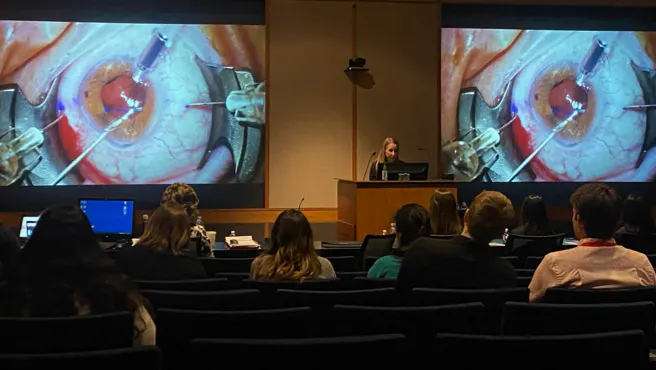
The program began, of course, with breakfast, where attendees had the opportunity to meet and mingle with other cornea fellows, as well as industry in between bites of croissants and sips of coffee. Fully charged, we found our seats in the auditorium for a full day of didactic lectures presented by the Duke faculty.
Each topic introduced and explored essential surgical procedures that many of us in the room had been gaining an understanding and skill in throughout our fellowship year. Instructors walked us through various procedures highlighting technique pitfalls, challenges, and tips for DMEK, DSAEK, DALK, MSICS, scleral fixation of intraocular lenses, MIGS, iris suturing, complex cataract, and more.
As this course was held during the back half of fellowship, we budding cornea surgeons were better able to appreciate the nuances of surgical movement, techniques, and tools discussed as we develop our skills and continue to build upon the fundamentals of these key procedures.
Although most of us are seemingly homogenous in our training, every program has its own practice patterns and strengths. Some programs are heavy in keratorefractive, others in ocular surface reconstruction, and others in complex anterior segment surgery. The structure of the program gave us all a great overview of medical and surgical concepts in all areas, despite a wide variety of experience.
After didactics, we had the opportunity to participate in an unparalleled wet lab experience with access to some of the latest technology and cutting edge procedures.
The importance of wet labs has repeatedly been shown to be beneficial in a young surgeon’s training.1 Wet labs provide a safe, risk-free and less stressful environment in which to learn surgical skills.2 Labs can encourage confidence to attempt novel methods and techniques, as well as improve psycho-motor skills and hand-eye coordination.3
One of the most valuable aspects of the lab was the unique opportunity to interact one on one with senior colleagues in order to gain hands-on experience. We rotated through stations organized for various lamellar corneal transplant techniques, iris repair, secondary intraocular lens placement, MSICS, pars plana vitrectomy, and MIGS procedures.
Following numerous procedures on donated pig and SimulEye eyes (which we were allowed to take home for practice), those fellows who chose to participate were bused to Drive Shack where we enjoyed an evening of embarrassing golf swings, craft beer, and tacos. But more importantly, we had the opportunity to candidly discuss our fellowship experiences, excitement about our new jobs, and everything in between as we all share the experience of transitioning into this new phase of life.
Those who chose to make a weekend out of their trip were invited to attend the annual Duke Controversies in Cornea and Cataract Surgery conference. Registration was waived to attend an engaging program with inspiring talks with visiting speaker John Berdahl, MD, and other cornea faculty, in addition to panel discussions, lectures, and updates in cornea, cataract, refractive and anterior segment surgery.
I thoroughly enjoyed my weekend in North Carolina and recommend all those incoming cornea fellows to keep an eye out for the next Duke Cornea Course in 2023.
1. G.C. Velmahos, K.G. Toutouzas, L.F. Sillin, et al., Cognitive task analysis for teaching technical skills in an inanimate surgical skills laboratory, Am J Surg 187 (2004) 114–119.
2. Almaliotis D, Athanasopoulos GP, Almpanidou S, Papadopoulou EP, Karampatakis V. The contribution of wet labs in the education of ophthalmologists. Ann Med Surg (Lond). 2021;72:103034. Published 2021 Nov 12. doi:10.1016/j.amsu.2021.103034.
3. D. Mishra, K. Bhatia, L. Verma, Essentials of setting up a wet lab for ophthalmic surgical training in COVID-19 pandemic, Indian J Ophthalmol 69 (2) (2021 Feb) 410–416.