
Sponsored by Glaukos
January 2026
Interventional glaucoma is procedure-based intervention with drops used as a bridge and supplemental therapy.
Christine Funke, MD; Deborah Ristvedt, DO; J. Morgan Micheletti, MD; and Arkadiy Yadgarov, MD
Recently, YoungMD Connect hosted an interactive, virtual webinar designed for medical students, residents, and practicing surgeons focused on interventional glaucoma (IG) and the evolving procedural-first paradigm in glaucoma care. Featuring Christine Funke, MD; Deborah Ristvedt, MD; Morgan Micheletti, MD; and Arkadiy Yadgarov, MD, this workshop aimed to promote a collaborative discussion around procedural-first approaches to glaucoma care.
To open the webinar, Dr. Funke discussed how glaucoma management is shifting from a reactive, drop-based model to a proactive, procedural-first approach. There is a paradigm shift happening in this space, she explained, as interventional glaucoma aims to intervene procedurally earlier in patients’ treatment course to reduce progression, improve compliance, and reduce burden. Dr. Funke also spoke on the various limitations of traditional glaucoma treatment approaches, such as overreliance on topical treatment, overuse of filtering and shunt surgeries, and stacking of medications.
Dr. Funke went on to emphasize a few of the numerous benefits of early intervention. She noted that, among patients who were treated with interventional glaucoma procedures, improved 24-hour intraocular pressure (IOP) control may be likely versus with topical therapy alone. Advanced Glaucoma Intervention Study (AGIS)—a multicenter, randomized controlled clinical trial evaluating two sequences of treatments in patients with advanced, medically uncontrolled open-angle glaucoma—underscores the importance of diurnal IOP fluctuation in glaucoma progression, especially in low-tension glaucoma patients, which reinforces the need for 24-hour IOP control via procedural means rather than drops alone.1 Another benefit of early drop-free interventions is improvement to patient quality of life and treatment efficacy. Many patients develop dry eye following topical medication use which contributes to patient non-adherence, worsening of disease, and patient discomfort.
Dr. Funke concluded by sharing many patients often suffer in silence, not knowing what to expect out of treatment or what questions to ask. Opening conversations about symptom burden and treatment alternatives is crucial, as visual field loss and patient quality of life are top concerns for clinicians, she said. Early procedural intervention supports both needs.
Next, Dr. Ristvedt shared expert insights on where to begin when building an interventional glaucoma practice. First, she recommended starting with a practice assessment; review how many glaucoma patients are on drops, as these are potential candidates for intervention. Identify early IG opportunities, such as pseudophakes with dry eye and patients needing both cataract surgery and glaucoma management. Second, Dr. Ristvedt suggested developing and implementing a protocol. Not all IG technologies need to be mastered at once; start with a few and expand once confidence grows. For example, cataract surgery plus MIGS is an ideal entry point for many who are beginning in this space. Lastly, Dr. Ristvedt encouraged attendees to engage the optometric community. Many ODs are still unaware of interventional glaucoma; outreach and education can shift referral patterns. She also recommended sharing treatment protocols, reinforcing co-management, and addressing concerns about losing patients post-referral with practice ODs. Dr. Ristvedt left attendees with a final pearl to “build a surgical referral network through trust, collaboration, and availability.”
Dr. Micheletti next conducted a real-world deep dive into glaucoma data from 42 practices.2 An expanded data analysis included 295 eye care professionals, approximately 50,000 patients, and 14,000 procedures. Most patients experienced mild-to-moderate glaucoma, which is ideal for performing procedural pharmaceuticals, SLT and MIGS, Dr. Micheletti explained. However, even in self-identified interventional practices, only 17% of patients were treated procedurally, and only 64% of glaucoma patients undergoing cataract surgery received MIGS, which is far from the ideal 100%.2 Other notable results included follow-up and disease monitoring data: 2,3
Dr. Micheletti emphasized that poor monitoring undermines early detection and progression control. He concluded with a reminder to attendees that even among interventional glaucoma-aligned practices, adoption is inconsistent, and more structured implementation is needed.
To conclude the workshop, Dr. Yadgarov shared expert insights on how practices can better implement systematized interventional glaucoma approaches, as well as why a consensus protocol is needed. Recognizing the inconsistency among practices, the Interventional Glaucoma Working Group—a consortium of glaucoma specialists focused on advancing the understanding, development, and clinical use of interventional glaucoma procedures—aimed to standardize decision-making and promote proactive treatment pathways. Various protocol highlights are included below (Figure).
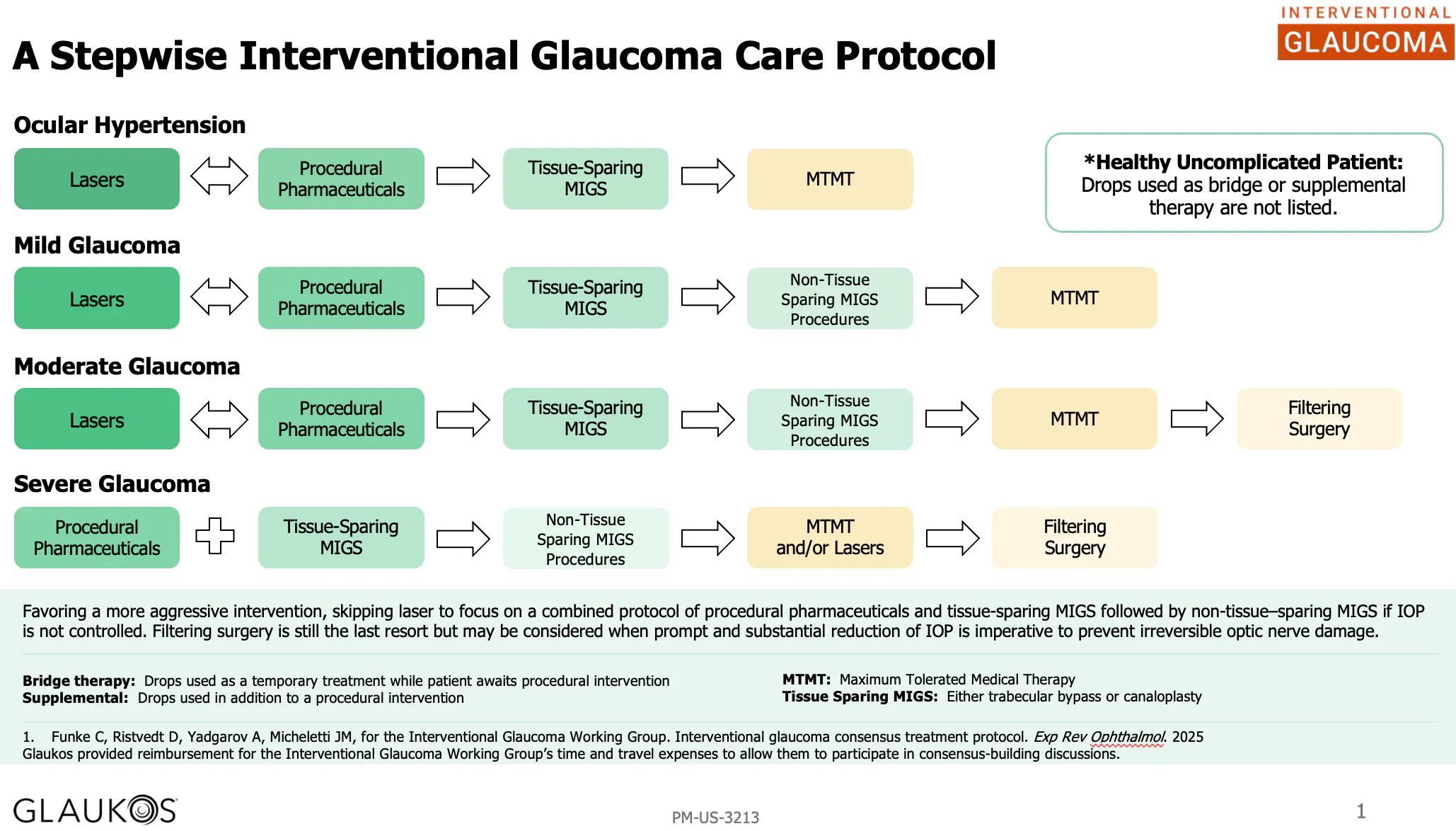
Figure. A proposed treatment roadmap from the published interventional glaucoma consensus treatment protocol.
Dr. Yadgarov explained to attendees that the overall goals of this consensus protocol were to promote safety and efficacy, reduce overreliance on noncompliant topical regimens, and encourage broader uptake by comprehensive ophthalmologists and optometrists.
This workshop brought together glaucoma experts to provide attendees with a comprehensive, data-driven overview of how interventional glaucoma is reshaping modern glaucoma care. The panelists agreed that interventional glaucoma represents a clinically validated, patient-centered future in glaucoma care, though significant educational and implementation gaps remain—even in forward-thinking practices. They echoed that adoption of consensus protocols and proactive collaboration with referring ODs will be critical to future success. Overall, the session underscored a unified message: embracing an interventional mindset is essential to improving long-term outcomes and elevating the standard of care for patients with glaucoma.
1. The AGIS Investigators. The Advanced Glaucoma Intervention Study (AGIS): Study design and methods and baseline characteristics of study patients. Control Clin Trials. 1994;15(4):299-325.
2. Glaukos, data on file.
3. Williams AM, Liang HW, Lin H-H S. Loss to follow-up and risk of incident blindness among patients with glaucoma in the IRIS® Registry (Intelligent Research In Sight). Ophthalmology Glaucoma. 2025 May 8;8(6):544-552. doi:10.1016/j.ogla.2025.05.001