


Authors’ note: Dr. De Rojas established the Center for Sight's dry eye protocol shortly after joining the practice in 2019 and identifying the need for more aggressive preoperative ocular surface care. Dr. Mathews brought her passion for corneal health to the Center for Sight in 2022, where she became Director of Cornea and Ocular Surface Disease and established a dedicated dry eye specialty clinic.
Eye care specialists have gained an increased understanding of the important role that ocular surface health plays in refractive outcomes, particularly in the case of premium cataract surgery with extended depth of focus or multifocal IOLs. We conducted an analysis of internal Center for Sight data (four surgeons, 113 eyes) and found that dry eye severity was the second most important factor in predicting patient dissatisfaction after advanced IOL surgery (P = .041), with the first being residual refractive error.
We knew that by aggressively managing ocular surface disease (OSD), we could further improve patients’ results and increase their satisfaction. Therefore, we began creating an approach to diagnosis and treatment that we could implement practice-wide and make easily available to all our comanaging optometrists and surgeons. This effort has been extremely successful over the past 4 years and led to the establishment of a dedicated dry eye specialty clinic.
THE MAKING OF A UNIFIED PROTOCOL
At Center for Sight, our goals for the dry eye initiative were fourfold: (1) improve and enhance vision among cataract and refractive surgery patients, (2) increase patient retention and satisfaction across the practice, (3) increase patient awareness and compliance, and (4) create new avenues for provider and practice growth.
To successfully integrate a proactive dry eye protocol into a multilocation practice with a large group of 50+ providers, including 15 MDs, along Southwest Florida, we knew it had to be as simple as possible for everyone to evaluate and treat the condition. We wanted to educate on a straightforward, systematic process for diagnosis and to provide a catalogued list of all recommended treatment options that we consider best-in-class, including prescription drops, over-the-counter products, and in-office procedures. The eye care provider can select applicable therapies from this list, and, at the conclusion of the visit, the selections from the handout are reviewed with the patient and the handout is sent home with them.
We offer most of the products we recommend in our offices. We consider this a form of quality control—we know that patients are getting the products we want them to use. Additionally, patients appreciate the convenience and can start their regimen immediately.
These treatments—which are constantly being updated and added to—are selected based on our comprehensive vetting, including our own and our peers’ experience with the products and an in-depth review of the research and evidence supporting the options we offer. It can be a time-consuming undertaking to catalogue all these treatments, but it is essential for establishing and maintaining credibility and buy-in with the providers and staff, not to mention securing patients’ trust. The treatment checklist also provides additional OSD education, streamlines the process for everyone involved, and helps minimize callbacks and repeat questions.
SYSTEMATIC APPROACH
Diagnosis
The assessment of tear film instability is divided into six steps, with two optional tests.
- Perform tear osmolarity testing (optional, no longer utilized at our practice)
- Place a fluorescein sodium drop in each eye, wait 2 minutes, and assess the cornea with cobalt blue light
- Review the patient’s history and symptoms
- Perform conjunctival surface staining with lissamine green (optional but recommended for dry eye consultations)
- Assess the corneal surface via staining to identify corneal surface pathology (eg, superficial punctate keratitis, punctate epithelial erosions, or epithelial basement membrane dystrophy) and determine tear breakup time (TBUT)
- Assess the eyelid for blepharitis, meibomian gland dysfunction (MGD), laxity, or lagophthalmos (ie, look, lift, push, pull)
Management
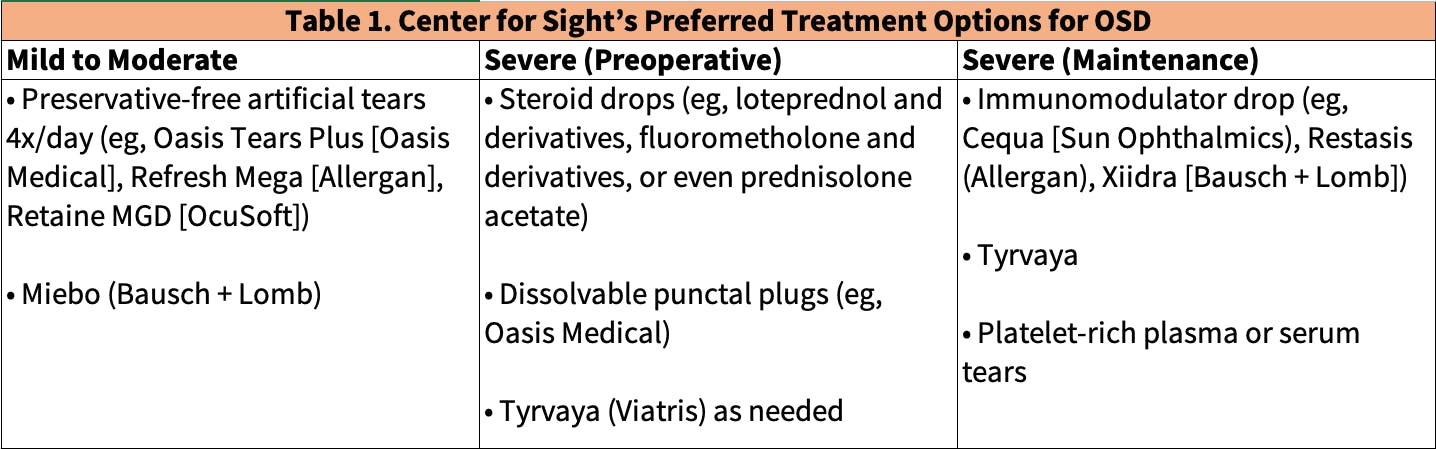
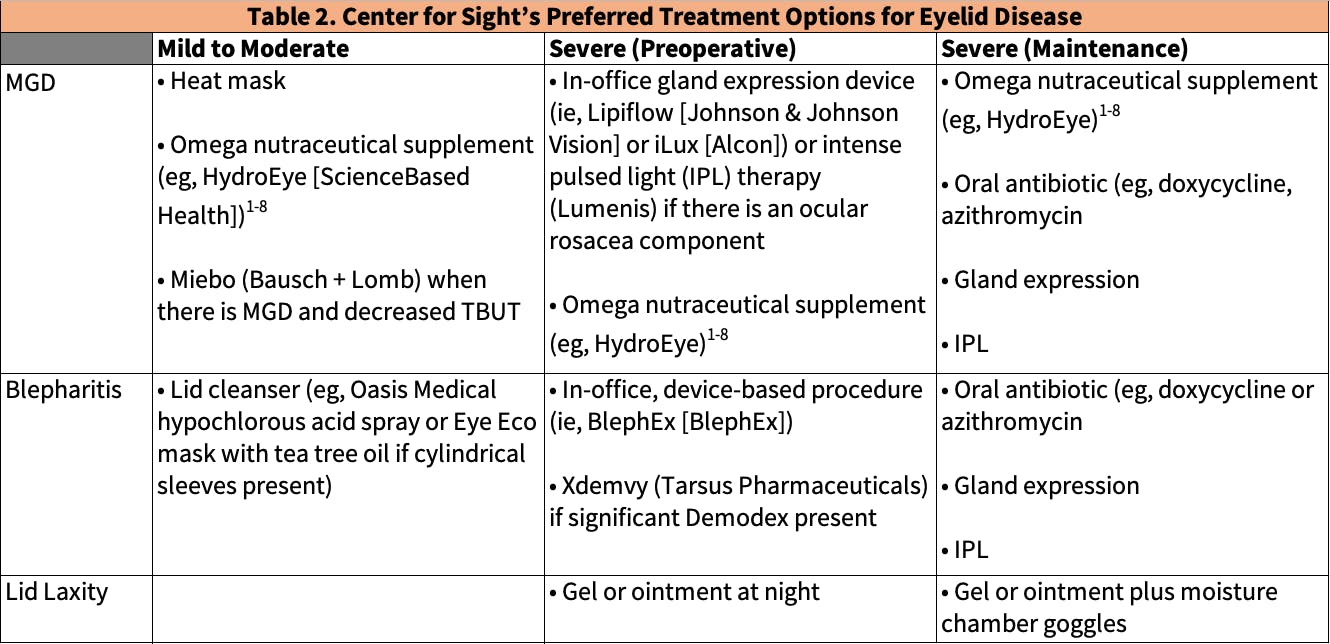
Our management algorithm is divided into two categories: OSD (Table 1) and eyelid disease (Table 2). Treatments are stratified according to severity of acute disease being treated in the preoperative setting (mild, moderate, severe) or into maintenance treatments that may be continued well after surgery at the discretion of the comanaging and primary eye doctor. Treatments occurring prior to surgery should be initiated at least 2 weeks before final biometry measurements are taken.
A DRY EYE SPECIALTY CLINIC
By creating a dry eye specialty clinic, we offer our providers the opportunity to “outsource” the management of moderate and severe dry eye cases if needed. For example, patients in whom first-line therapies have failed can be easily referred to the dry eye specialty clinic. Our physician’s assistant trained with us for more than 1 year and has greatly expanded the number of dry eye patients we can manage. She has been invaluable to our ability to offer procedures such as iLux, IPL, and allergy testing and provide platelet-rich plasma drops (which requires patients’ blood to be drawn in house). Additionally, we try to schedule follow-up exams and procedures on the same day to make the visit as efficient as possible for the patient and ourselves.
Our providers now have access to even more advanced tools in their arsenal, and we can treat a wider range of patients regardless of their surgical status. The dry eye landscape is rapidly evolving, and we are always reevaluating the products and procedures we offer to ensure that patients can access the best therapies available. We review and update our guidelines and the treatments listed above every 6 months.
CONCLUSION
Our primary reason for establishing a unified protocol for dry eye in our high-volume surgical practice is to improve our outcomes and increase patient satisfaction. Furthermore, we believe that treating OSD can be a collegial, practice-wide initiative that benefits our ophthalmologists, optometrists, physician extenders, and patients alike.
1. Sheppard JD Jr, Singh R, McClellan AJ, et al. Long-term supplementation with n-6 and n-3 PUFAs improves moderate-to-severe keratoconjunctivitis sicca: a randomized double-blind clinical trial. Cornea. 2013;32(10):1297-1304.
2. Kapoor R, Huang YS. Gamma linolenic acid: an antiinflammatory omega-6 fatty acid. Curr Pharm Biotechnol. 2006;7(6):531-534.
3. Barabino S, Rolando M, Camicione P, et al. Systemic linoleic and gamma-linolenic acid therapy in dry eye syndrome with an inflammatory component. Cornea. 2003;22(2):97-101.
4. Macrì A, Giuffrida S, Amico V, Iester M, Traverso CE. Effect of linoleic acid and gamma-linolenic acid on tear production, tear clearance and on the ocular surface after photorefractive keratectomy. Graefes Arch Clin Exp Ophthalmol. 2003;241(7):561-566.
5. Aragona P, Bucolo C, Spinella R, Giuffrida S, Ferreri G. Systemic omega-6 essential fatty acid treatment and PGE1 tear content in Sjögren’s syndrome patients. Invest Ophthalmol Vis Sci. 2005;46(12):4474-4479.
6. Kokke KH, Morris JA, Lawrenson JG. Oral omega-6 essential fatty acid treatment in contact lens associated dry eye. Cont Lens Anterior Eye. 2008;31(3):141-146.
7. Pinna A, Piccinini P, Carta F. Effect of oral linoleic and gamma-linolenic acid on meibomian gland dysfunction. Cornea. 2007;26(3):260-264.
8. Brignole-Baudouin F, Baudouin C, Aragona P, et al. A multicentre, double-masked, randomized, controlled trial assessing the effect of oral supplementation of omega-3 and omega-6 fatty acids on a conjunctival inflammatory marker in dry eye patients. Acta Ophthalmol. 2011;89(7):e591-597.