





At first glance, the phrase global refractive surgery may seem counterintuitive. Typically, when global ophthalmology is mentioned, the first intervention that comes to mind is cataract surgery or, more specifically, an effort to reverse blindness in elderly patients affected by dense cataracts that have been worsening for decades. But what about tackling the other leading cause of moderate and severe vision impairment, refractive error?1
It might seem like this would entail setting up a modern, expensive laser system and offering high-cost spectacle independence to patients who can barely afford glasses. After all, elective refractive procedures are a luxury available only to those who can afford them, right? As someone who was born in a small village in Yemen, I certainly find the idea of placing a costly laser in a low-resource area with limited electricity to sound like an impossible dream. So, what exactly am I talking about with global refractive surgery, and is it possible?
THE WHAT
According to a Lancet Global Health Commission report, an estimated 1.3 billion people globally are affected by uncorrected vision impairment, with refractive error being the most common cause.2 A significant lack of access to eye care services affects many parts of the world, with low-income countries having only one ophthalmologist for every 1 million people.
The social and economic costs of untreated refractive error include decreased quality of life, increased poverty, and an estimated $411 billion annually in lost productivity. Figure 1 illustrates the relationship between eye health and the United Nations’ Sustainable Development Goals, highlighting the numerous and profound societal effects of eye care. Refractive error represents the greatest cause of visual impairment worldwide, and therefore causes a significant burden for the underserved.2 Increased access to quality eye care services, including refractive surgery, is urgently needed to address this issue and improve the overall health and well-being of communities.
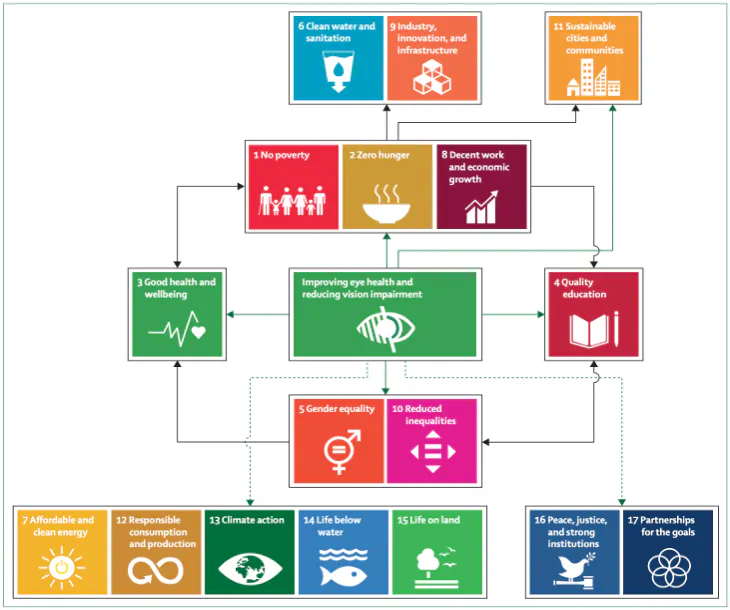
Figure 1. The relationship between eye health and the United Nations’ Sustainable Development Goals, a group of broad target-driven goals designed to serve as a blueprint to achieving a more sustainable future for all.
THE WHY
When I felt conflicted about which subspecialty to pursue during residency, I returned to my core reason for entering ophthalmology: to serve humanity by helping people see, especially those in dire need. In developing countries, many individuals (both young and old) who suffer from refractive error are dependent on others for assistance with daily tasks. Imagine what the world looks like to a young adult with 6.00 D of myopia (Figure 2) who wants to earn a living but cannot afford glasses. This automatically limits the types of jobs they can perform and strips them of the freedom to choose the job they want most.

Figure 2. Simulation of a classroom view through 6.00 D of uncorrected myopia.
Global refractive surgery is the key to helping these individuals unlock their independence. Improved vision may afford an individual the ability to perform certain tasks on their own, which may help improve their confidence, self-esteem, and overall quality of life. Refractive surgery offers several advantages over spectacles or contact lenses, including a permanent solution with a one-time cost as well as a longer expected lifespan for the patient.
THE HOW
Various global refractive surgery projects have been implemented to address the issue of untreated refractive error in developing countries. One example is the collaboration between the London Vision Clinic and the Himalayan Cataract Project to create a state-of-the-art refractive surgery unit in Nepal, one of the poorest countries in Asia. The partnership involved training an experienced Nepali ophthalmologist in the latest refractive surgery techniques at the London Vision Clinic. Subsequently, a framework was established to provide necessary equipment and support to create a new unit in Nepal.3
This initiative has been successful in providing affordable and effective eye care, improving quality of life, and reducing the burden of blindness in Nepal. It exemplifies the essence of the proverb “If you give a man a fish, you feed him for a day. If you teach a man to fish, you feed him for a lifetime,” and it is an effective step toward achieving sustainable global eye care.
CONCLUSION
Global refractive surgery has immense potential for addressing the widespread issue of uncorrected vision impairment due to refractive error. Trainees should take time to explore the organizations, NGOs, and initiatives doing work in this area, as there may be opportunities to get involved in these efforts, even on a smaller scale. Whether through volunteering, offering expertise, or donating to fundraising initiatives, every contribution can make a difference in improving eye care accessibility and transforming lives.
In our shared pursuit of sustainable global eye care, let us embrace the possibilities of global refractive surgery and work together to ensure that no individual is denied the chance to see a brighter future. Through innovative solutions, collaboration, and unwavering dedication, we can make vision a reality for millions, one surgery at a time.
1. Bourne R, Steinmetz JD, Flaxman S, et al; GBD 2019 Blindness and Vision Impairment Collaborators. Trends in prevalence of blindness and distance and near vision impairment over 30 years: an analysis for the Global Burden of Disease Study. Lancet Glob Health 2021;9(2):e130–e143.
2. Burton MJ, Ramke J, Marques AP, et al. The Lancet Global Health Commission on Global Eye Health: Vision Beyond 2020. Lancet Glob Health. 2021;9(4):e489-e551.
3. Reinstein DZ, Carp GI, Pradhan KR, et al. Role of laser refractive surgery in cross-subsidization of nonprofit humanitarian eyecare and the burden of uncorrected refractive error in Nepal: Pilot project. J Cataract Refract Surg. 2018;44(8):1012-1017. doi:10.1016/j.jcrs.2018.05.023
_1753895074.jpg)
