

Access to eye care remains a significant and growing challenge in communities of low socioeconomic status across the United States. Diabetic retinopathy (DR), in particular, is the leading cause of visual impairment among working age adults in the United States.1 Early detection is critical for preventing or slowing progression to vision loss. Screening programs or comprehensive dilated eye exams make it possible for eye care providers to identify disease in its early stages and initiate treatment in a timely manner.
Western Massachusetts, the region in which I grew up, was affected by a scarcity of local eye care resources. Our community hospitals lacked an ophthalmology department, and the nearest eye care center was more than a 50-minute drive away. This limited access left many families without timely or adequate care. My passion for medicine and equitable access to health care has drawn me to telescreening and telehealth, innovative tools with potential to reduce barriers to eye care, particularly for underserved rural communities across the country.
IDENTIFY COMMUNITY NEED
I first learned about the newly implemented AEYE Diagnostic Screening (AEYE-DS, AEYE Health) autonomous screening program for DR through an announcement and presentation at my home institution, University of Massachusetts Memorial Health in Worcester, Massachusetts. Intrigued, I explored the program further and was impressed by its use of a handheld camera to capture retinal images; these images are then automatically uploaded to the AEYE-DS software, which uses AI to detect signs of DR (Figure). Recognizing the profound potential of this technology to improve access to vision screening, especially in rural and underserved communities, I was immediately motivated to become involved in its implementation.
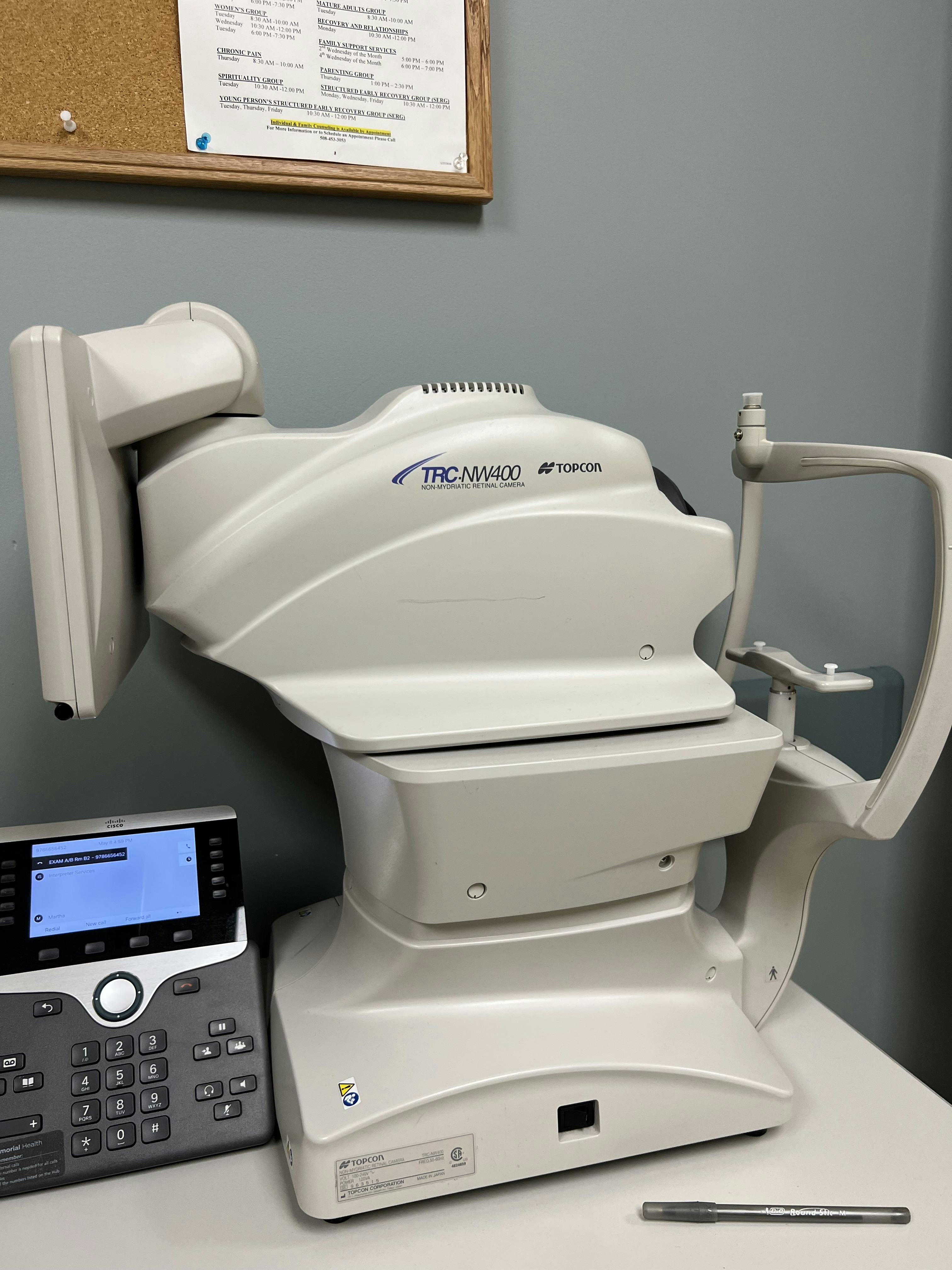
Figure. The fundus camera pictured is used for diabetic retinopathy telescreening at a University of Massachusetts Memorial Health family health center in Fitchburg, Massachusetts.
In the 2021 Worcester Community Health Assessment, diabetes was identified as a major health issue for the Hispanic/Latino population in Worcester. That year, 8% of the adults in the city were diagnosed with diabetes.2 Barriers to early detection of DR among marginalized communities include financial constraints, lack of time, transportation issues, and language difficulties.3,4
Within the UMass Memorial Health system, one major challenge identified for the growing population of patients with diabetes was difficulty scheduling annual eye exams with ophthalmologists. Many patients reported transportation issues, work or child-care responsibilities, and copays as contributing factors.5 These findings highlight the importance of engaging with the community to identify specific obstacles to accessing eye care and designing solutions to address them.
CONNECT AND COLLABORATE WITH SPECIALISTS
Early on, I reached out to the then project leads, Juan Ding, OD, and James Ledwith, MD, to explore how I could contribute to the expansion of the DR screening initiative. Through a series of collaborative brainstorming sessions, we developed plans to launch the program at two family health centers in Fitchburg and Barre, Massachusetts.
I was particularly interested in leading the development of the educational training materials, which are required for the in-person training sessions that occur prior to implementing the screening protocol in primary care clinics across the UMass health care system. After preparing and submitting to the Institutional Review Board, I created comprehensive training modules and instructional videos. These materials covered DR pathology and classification as well as hands-on guidance for using the AEYE-DS program’s handheld retinal camera. They were designed for medical assistants, nurses, and family medicine residents working in the targeted clinics.
As part of this project, we evaluated the effectiveness of the DR educational course. A pre- and post-course survey was administered to all participants to assess baseline knowledge of DR, perceived effectiveness of the training, and comfort with operating the handheld retinal camera. The data collected provided valuable insights into both the strengths of the training and areas for improvement.
PROGRAM RESULTS AND ONGOING SUCCESS
Within 4 months of implementing the AEYE-DS system, annual DR screening adherence of patients at the Fitchburg Family Medicine clinic rose from 29% to 49%.5 The AEYE-DS program continues to expand and is in the process of being implemented in multiple UMass health care locations, contributing to broader efforts to improve early detection and access to vision care.
Building on the skills and experience I gained, I also had the opportunity to collaborate with another DR telescreening initiative based in the greater Boston area. This project focused on analyzing patient demographics and evaluating whether the telescreening program led to increased follow-up with in-person ophthalmology visits.
CONCLUSION
Telemedicine has great potential to increase screening rates and expand access to care, particularly for underserved populations. If you are interested in getting involved, the first step is to connect with professionals in the field, explore where your passions align, and identify where you can contribute to ongoing efforts. Whether through research, implementation, or education, there are many opportunities to make a meaningful impact.
1. Kropp M, Golubnitschaja O, Mazurakova A, et al. Diabetic retinopathy as the leading cause of blindness and early predictor of cascading complications-risks and mitigation. EPMA J. 2023;14:21-42.
2. Greater Worcester Community Health Needs Assessment. Worcester Division of Public Health. September 2021; 63-64. Accessed August 22, 2025. https://www.worcesterma.gov/building-a-healthy-community/cha/2021-cha.pdf
3. Lu Y, Serpas L, Genter P, Anderson B, Campa D, Ipp E. Divergent perceptions of barriers to diabetic retinopathy screening among patients and care providers, Los Angeles, California, 2014–2015. Prev Chronic Dis. 2016;13:160193.
4. Zhu X, Xu Y, Lu L, Zou H. Patients’ perspectives on the barriers to referral after telescreening for diabetic retinopathy in communities. BMJ Open Diabetes Research & Care. 2020;8:e000970.
5. UMass Memorial Health enhances diabetic eye care adherence with AEYE‑DS autonomous screening. AEYE Health. December 10, 2024. Accessed August 27, 2025. www.aeyehealth.com/umass-case-study