
Editorially independent content, supported with advertising from ZEISS
April 2025
I. Paul Singh, MD; Sahar Bedrood, MD, PhD; Julie Schallhorn, MD, MS; and Carl D. Regillo, MD, FACS, FASRS
In the Innovation Journal Club (IJC) series on Eyetube.net, host I. Paul Singh, MD, of The Eye Centers of Racine & Kenosha in Wisconsin, interviews leading experts from across eye care subspecialties about emerging innovations and technologies that may prove influential to the real-world practice of ophthalmology. The series is editorially independent (supported by advertising from multiple companies), which allows the discussions to be broad in scope and candid in presentation.
The following is a summary of three episodes in which Dr. Singh spoke with Sahar Bedrood, MD, PhD, about changes in MIGS reimbursement and how they affect procedural selection; Julie Schallhorn, MD, MS, about advancements in monofocal IOL technology; and Carl D. Regillo, MD, FACS, FASRS, about the emergence of second-generation anti-VEGF drugs for the treatment of age-related macular degeneration (AMD).
A change in coding and reimbursement for MIGS procedures implemented in January 2022, which resulted in a 90% reduction in reimbursement for all trabecular meshwork bypass stenting procedures, appears to have driven an increase in canal-based procedures and a decrease in angle-based procedures after the cuts were implemented.1
An analysis of national claims data from a 5% sample of all Medicare beneficiaries compared glaucoma procedure counts between the first quarter of 2021 and the first quarter of 2022.1 According to the investigators, the utilization of angle-based stenting procedures, including the Hydrus Microstent (Alcon) and iStent (Glaukos), decreased by about 20,960 procedures between 2021 and 2022.1 As well, there were increases in goniotomy procedures by an estimated 11,680 cases and canaloplasty procedures by about 6,640 cases between the 2 years (Figure 1).1 Taken together, these data suggested a shift in procedural selection among ophthalmic surgeons, which was most likely driven by coding and reimbursement changes implemented in January 2022.1
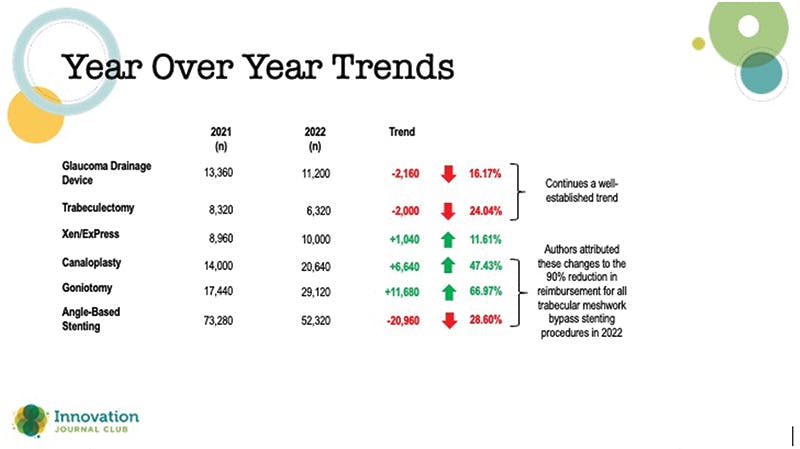
Figure 1. Comparisons in procedural counts in 2021 and 2022 in an analysis of national claims data from a 5% sample of all Medicare beneficiaries.
While it is unclear what impact the shift in procedural choice had on patients’ outcomes, the analysis nevertheless points to the effects of the evolving reimbursement landscape on physician behavior.
“[As human beings], we are driven by different factors. One is innovation, one is what the patient needs, and one is reimbursement because this is our job,” said Dr. Bedrood, commenting on the results. “When that changes, it changes our behavior; that's what the study showed.”
There may be additional insurance issues providers will need to be mindful of. For example, a new local coverage determination that became effective in November 2024 restricts reimbursable procedures to cataract plus one stent device per eye, effectively ending reimbursement for combination MIGS procedures. Fundamentally, these kinds of changes challenge physicians to continue making decisions that are in the best interest of patient care in the context of various financial rules non-physicians implement.
“The onus is really on us as physicians to act responsibly, to not overuse certain codes. I think there's also an onus on both industry and doctors to give data,” Dr. Bedrood concluded. “Without that, we are not going to be able to reverse any of these things. There is a responsibility on our behalf to help ourselves and help our patients.”
1. Williams PJ, Hussain Z, Paauw M, et al. Glaucoma surgery shifts among Medicare beneficiaries after 2022 reimbursement changes in the United States. J Glaucoma. 2024;33(1):59-64.
In this episode, Dr. Schallhorn discussed a retrospective study assessing the visual and refractive outcomes after implantation of the CT Lucia 621P (ZEISS).1
The CT Lucia 621P is an optimized non-constant aberration-correcting monofocal IOL that features negative spherical aberration in the center that gradually reduces to zero aberration in the periphery. According to Dr. Schallhorn, the unique design makes the lens highly tolerant to decentration and tilt.
For the study, investigators reviewed early clinical outcomes and adverse events after unilateral or bilateral implantation of the CT Lucia 621P in 191 eyes of 133 patients.1 Results demonstrated the mean postoperative monocular uncorrected distance visual acuity (UDVA) was 0.09 ±0.16 logMAR (~20/25), and 74.9% (143 of 191) eyes achieved better than or equal to 20/25 UDVA (Figure 1). Additionally, the percentage of eyes with manifest spherical equivalent (MSE) within 0.50 D and 1.00 D of emmetropia was 84.8% (162 of 191) and 98.4% (188 of 191), respectively (Figure 2).
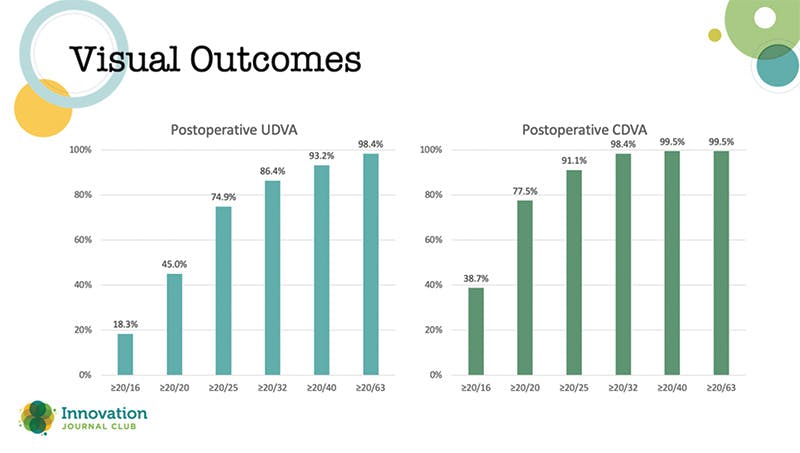
Figure 1. Measured postoperative UDVA (left) versus postoperative CDVA (right) following implantation of the CT Lucia 621P IOL.
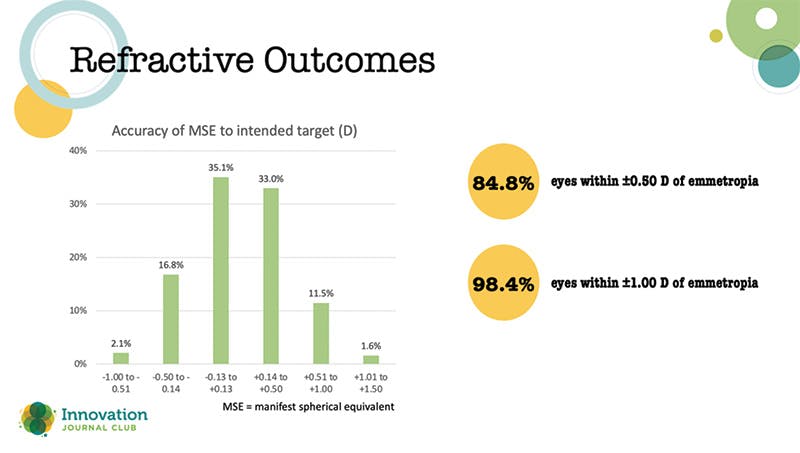
Figure 2. Recorded refractive outcome data, highlighting the accuracy of MSE to intended target in eyes that received the CT Lucia 621P.
Reflecting on the trial data and the various ways in which new IOL monofocal advances continue to drive the field forward, Dr. Schallhorn noted that eye care professionals have come to understand that there are a lot of nuances to the optical system of the eye.
“There's a lot of nuances to the lens, such as how it goes in and how it sits. The optical properties of that lens can all be optimized to really improve the quality of vision for our monofocal IOL patients,” she concluded. “Every patient deserves the best possible outcome. Whether that’s premium IOL or monofocal IOL, you want patients to get the best possible treatment.”
1. Schallhorn S, Teenan D, Venter J, et al. Early Clinical experience with a new hydrophobic acrylic single-piece monofocal intraocular lens. Clin Ophthamol. 2023;17:3419-3427.
The introduction of anti-VEGF drugs nearly 2 decades ago significantly changed the prognosis for preserving long-term vision for patients with neovascular age-related macular degeneration (nAMD).
However, the first generation of anti-VEGF agents to enter the market, including ranibizumab (Lucentis, Genentech) and aflibercept (Eylea, Regeneron), as well as the off-label use of bevacizumab (Avastin, Genentech), are not without their limitations. For example, results in real-world studies are considerably poorer that those reported in randomized trials of these drugs.1 The cause of the latter is multifactorial, but it is at least in part driven by the fact that real-world patients are often treated with regimens that differ from the fixed dosing used in pivotal trial programs. In one study analyzing data from 13,859 patients in the IRIS Registry, for instance, patients treated with bevacizumab, ranibizumab, or aflibercept received about six injections over a 1-year period.2
“With first-generation anti-VEGFs, the mean durability of the anti-VEGF agents we’ve been using is about 8 weeks, with a range of 4 to 12 weeks. So that means, on average, you’re injecting about every other month—and some patients can get to your office pretty easily every other month, and some can’t,” Dr. Regillo said. “We know that the reality is, in the real world, there are visual acuity declines on average, because we can’t really get the adherence we need to maintain the vision outcomes we get early on when we start treatment.”
According to Dr. Regillo, the cumulative evidence and experience in real-world settings has highlighted an unmet need for more durable VEGF inhibition, a treatment gap that appears to have been filled, at least in part, by the introduction of the so-called second-generation anti-VEGF inhibitors aflibercept 8 mg (Eylea HD, Regeneron) and faricimab-svoa (Vabysmo, Genentech) (Figure 1). Aflibercept 8 mg is the same molecule as in standard-dose aflibercept (2 mg), but the higher dose provides for longer duration of VEGF inhibition. Faricimab-svoa is a structurally unique bispecific antibody targeting both VEGF and angiopoietin-2, which is suspected to have a role in the pathogenesis of retinal vascular disorders.
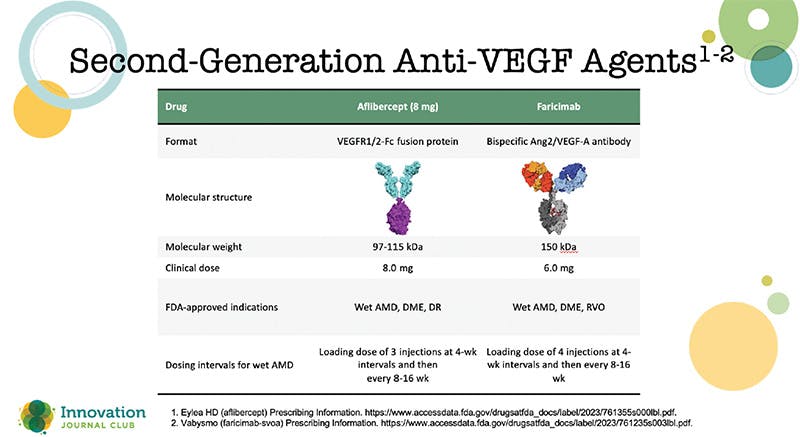
Figure 1. Second-generation anti-VEGF agents offer the potential for greater durability, meaning longer intervals between injections.
In the phase 3 PULSAR trial, aflibercept 8 mg demonstrated non-inferior BCVA gains at 48 weeks compared to aflibercept 2 mg, which was the primary endpoint. However, patients in the 8-mg group were able to achieve significantly longer treatment intervals relative to what would be possible with 2-mg dosing (Figure 2).
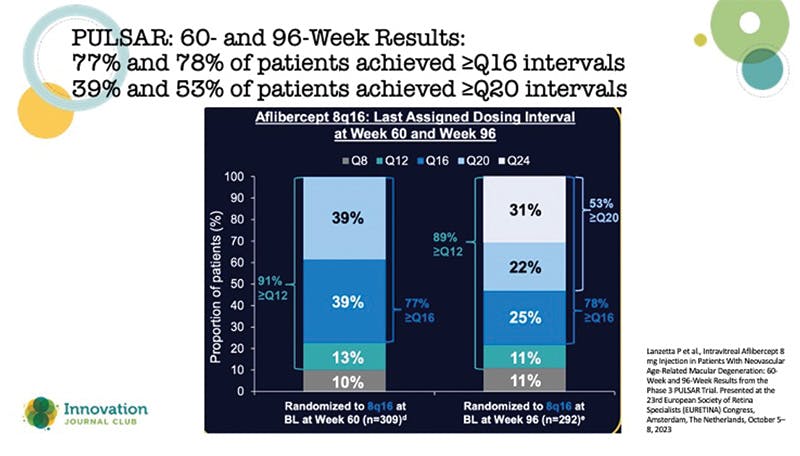
Figure 2. Percentage of patients randomized to high dose aflibercept achieving extended dosing in the phase 3 PULSAR trial.
“It didn't give us, on average, better visual outcomes, but it did give us quite a bit better durability,” said Dr. Regillo. “When you compare the durability, we're looking at well over half the patients getting out to 16 weeks. And in year 2 of the study, we could even go 20 weeks, which is pretty darn impressive.”
Farcimab-svoa was studied in nAMD in the TENAYA/LUCERNE phase 3 clinical trial program. Each study demonstrated that farcimab-svoa was non-inferior in mean change in BCVA from baseline compared to 2-mg aflibercept. However, a significant proportion of patients were able to achieve those vision gains with dosing intervals of 12 weeks or greater (Figure 3).
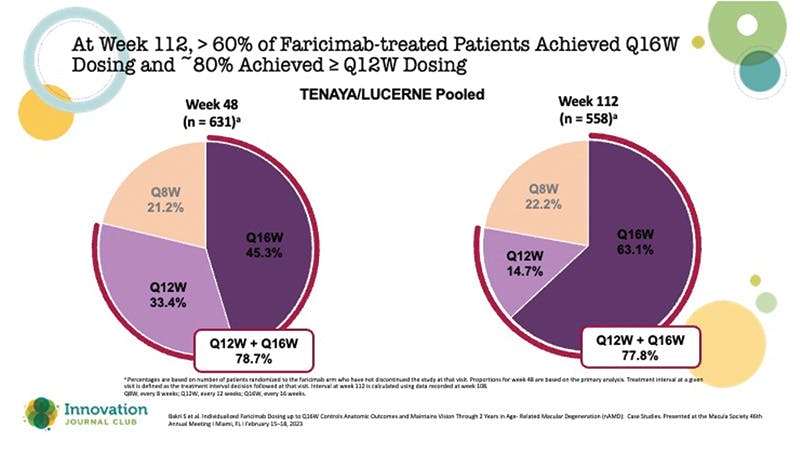
Figure 3. Percentages of patients achieving 12-week or greater treatment intervals with faricimab at weeks 48 and 112 in a pooled analysis of the phase 3 TENAYA/LUCERNE study.
“And that's the beauty of what we saw in the phase 3 trials with three-quarters or so of patients being dosed at 12- to 16-week intervals at the week 48 primary endpoint, and over one-half at 16 weeks by the end of year 2. There's no way that we could have achieved that with first-generation drugs based on personal experience and what has been published to date,” said Dr. Regillo.
1. Chong V. Ranibizumab for the treatment of wet AMD: a summary of real-world studies. Eye (Lond). 2016;30(11):1526.
2. Rao P, Lum F, Wood K, et al. Real-world vision in age-related macular degeneration patients treated with single anti-VEGF drug type for 1 year in the IRIS Registry. Ophthalmology. 2018;125(4):522-528.