
Editorially independent content, supported with advertising from Zeiss
March 2024
I. Paul Singh, MD; Karl G. Stonecipher, MD; Daniel S. Durrie, MD; and Gary Wörtz, MD
In the Innovation Journal Club (IJC) series on Eyetube.net, host I. Paul Singh, MD, of The Eye Centers of Racine & Kenosha in Wisconsin, interviews leading experts from across eye care subspecialties about emerging innovations and technologies that may prove influential to the real-world practice of ophthalmology. The series is editorially independent (supported by advertising from multiple companies), which allows the discussions to be broad in scope and candid in presentation.
The following is a summary of three episodes in which Dr. Singh explored the growing premium IOL market with Karl G. Stonecipher, MD; took a deep dive on the advent of office-based surgery with Daniel S. Durrie, MD; and discussed the ins and outs of low astigmatism management with Gary Wörtz, MD.
Karl G. Stonecipher, MD
The growing number of premium IOL options available to surgeons offers both opportunities and challenges, according to Karl Stonecipher, MD. More options means better customization for patients, but it also equates to potentially more confusion when making a lens recommendation, Dr. Stonecipher told host I. Paul Singh, MD, in an episode of Innovation Journal Club. The two physicians discussed the perennial challenge of finding the most suitable IOL for each patient’s needs amidst the plethora of options available. Dr. Stonecipher said a good number of patients come to him for a lens recommendation that will offer glasses-free reading vision. Most of these patients, he said, have had a prior procedure.
“We are all trying to figure out an IOL that works for these patients,” Dr. Stonecipher explained to Dr. Singh. “We don’t want to create dysphotopsias.”
One recently available option—and one that may have broader applications than currently appreciated—is the small-aperture IC-8 IOL (Apthera; AcuFocus). These lenses work on the same pinhole-effect principle as the small apertures used in camera lenses and telescopes. By blocking peripheral, defocused light, they alter the eye’s depth of focus and depth of field at all ranges, something not possible with monofocal IOLs. And although these lenses are meant to be paired with a monofocal or monofocal toric IOL in the contralateral eye, Dr. Stonecipher has tried them bilaterally in certain patients.
Dr. Stonecipher described a study in his clinic in which the small-aperture lens was used with patients with complex corneas: those who have undergone LASIK or other refractive procedures; those affected by keratoconus; and more. (unpublished data). He first implanted one in the patient’s worst-seeing eye, and then he offered the option of having it implanted in their second eye. “Everyone really surprised me. Everyone chose to have the small aperture optics in the second eye." While he isn’t advocating that bilateral implantation of small-aperture IOLs is broadly applicable to many patients, Dr. Stonecipher does see a niche for them in patients who are not good candidates for premium IOLs. “If I can attain 20/30 UCVA at near, these people are functional.”
So far, he has not heard complaints about the lens decreasing contrast sensitivity, and no one has asked to have the lens removed. He stressed that there is one caveat with a small-aperture lens: it will mask astigmatism. “So, when you refract these patients postoperatively, you may still pick up some astigmatism, because it’s not treating the astigmatism, per se, like you have with a typical toric lens.“
The two surgeons agreed that the small-aperture lens was surprisingly forgiving about centration, too. But that does not mean surgeons should give short shrift to the typical preoperative protocols. Dr. Stonecipher still treats any symptoms of dry eye disease (DED) to optimize biometry in these patients, and he still calculates the eye’s A-constant as best he can, given its condition after any prior surgeries. In terms of correction, he said, “I target about -0.75 D, and I think that’s the sweet spot.“
With the plethora of IOL options now available, the two surgeons discussed how they choose between them. “Do you look at what patients want, and then see how their cornea looks? Or do you say, here’s my go-to?“ Dr. Singh asked Dr. Stonecipher.
Dr. Stonecipher replied that experience has taught him that patients generally want their doctor to make a professional recommendation for an IOL, and so he tends to limit their choice between a premium option and an affordable option. He prefers a monofocal lens in eyes that have less than 0.75 D of astigmatism, and either the TECNIS Toric (Johnson & Johnson Vision), the TECNIS Eyhance Toric (Johnson & Johnson Vision), or perhaps the Aspire (Bausch + Lomb), in astigmatic eyes. He still uses trifocals such as the TECNIS Synergy (Johnson & Johnson Vision) or the PanOptix (Alcon), he said, if the patient has “perfect corneas.“ He added that he implants the Clareon Vivity IOL (Alcon) fairly often: “I find that’s a very forgiving extended depth-of-focus lens.“
Dr. Singh said he’s been using the Light Adjustable Lens (LAL; RxSight) frequently in eyes with DED and glaucoma, and he likes the quality of vision it imparts. And, he added, his patients love the idea of being able to adjust the refraction postoperatively if needed. Yet, the LAL does not address higher-order aberrations, Dr. Singh qualified. For eyes with irregular astigmatism, post-RK incisions, or peripheral irregularities, he said, “I think the IC-8, or the Apthera lens, makes some more sense.“
Both surgeons have performed blended vision implantations, with a standard monofocal lens in one eye and perhaps an Apthera in the other, targeting -0.75 to -0.50 D for a good range of vision.
Daniel S. Durrie, MD
The concept of office-based surgery (OBS) is neither new nor novel in medicine, having been established as an option for select procedures in dermatology (Moh’s surgery), dentistry, and cosmetic surgery. The next wave of this growing trend may well be in ophthalmology.
Daniel S. Durrie, MD, who serves as Chairman of iOR partners, a company that assists ophthalmologists in establishing and maintaining office-based surgical suites, joined host I. Paul Singh, MD, in an episode of Innovation Journal Club to discuss some of the nuances of OBS in ophthalmology, including what may be the biggest question: Is it safe for patients?
According to Dr. Durrie, the short answer to that question is yes, and he has data to back that assertion. When he joined iOR, Dr. Durrie encouraged his partners to track safety outcomes in all procedures performed in office surgical centers the company is involved with. To date, there are data on over 47,000 unique procedures (Figure), and they demonstrate safety outcomes that are comparable to historical benchmarks from published studies of procedures performed in either ambulatory surgery centers (ASCs) or hospital-based outpatient departments (HOPDs).
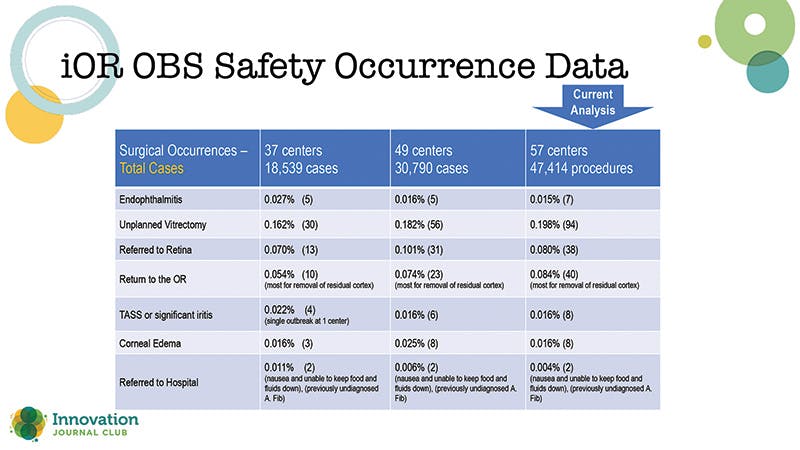
Figure 1. Data on office-based surgery (OBS) performed at centers within the iOR Partners network.
The investigators concluded that, with appropriate protocols, ophthalmic OBS can be performed safely. The analysis is ongoing, and Dr. Durrie expects to amass data on upwards of 70,000 cases by the end of 2024. He has submitted the results of the study for publication in the ophthalmic journals. As he has continued to collect procedure data, he said that the safety rate is staying the same over time.
“It’s safe, as long as you follow a good protocol,” Dr. Durrie said, “as long as you have accreditation standards and do good surgery. We now have three viable safety options, OBS, ASC, and HOPD.“
This is not the first study to show promising safety data on office-based cataract surgery. In 2016, Ianchulev et al published the results of a retrospective consecutive case series of more than 21,000 cataract surgeries that were performed as office-based procedures.1 The investigators found low rates of intra- and postoperative adverse events (and none that threatened vision or life), and they concluded that “Office-based efficacy outcomes were consistently excellent, with a safety profile expected of minimally invasive cataract procedures performed in ASCs and HOPDs.”
Dr. Durrie recounted to Dr. Singh that he is no stranger to the topic of OBS. In fact, he has been working most of his career to advance the idea, provided it could be proven safe. He was one of the first physicians in the country to offer outpatient cataract surgery in the late 1970s, at a time when patients were typically admitted to the hospital and observed for up to 3 days postoperatively.
“In December of 1979, the hospital was going to kick me off my staff, and my partners were going to kick me out of the office, because I was such a rebel. I thought it was good for patients and stuck with it, and, obviously, outpatient cataract surgery grew.”
Later, when ASCs came of age in the 1980s and 1990s, Dr. Durrie was again on the frontlines, working to form professional societies and encouraging better accreditation standards. Finally, he was at the forefront of the movement to move excimer lasers out of hospitals and ASCs and into dedicated, office-based laser suites so patients could gain easier access to LASIK.
Since those experiences were “fun and disruptive” for Dr. Durrie, he has spent the past decade working toward a wider adoption of OBS for many more types of ophthalmic surgery. Although his safety data are currently dominated by cataract procedures, he said he is seeing growth in office-based glaucoma and retina procedures as well.
The difference between OBS, an ASC, and an HOPD, Dr. Durrie explained, is that OBS falls under the physician’s license or the practice’s license. “It isn’t a separate facility,” he said. Each of these three models has its place in the system of ocular care, Dr. Durrie told Dr. Singh. “[ASCs] are great, as long as you have the volume and the diversity of practice to do that. But [OBS] is more for the smaller practice, or somebody who can’t do an ASC in their state, or somebody who’s putting it in their satellite office.”
Dr. Durrie also sees OBS as a potential answer to the growing disparity between supply and demand in ophthalmology. The rate of cataract procedures is expected to grow over the next 5 years, yet the total number of practicing ophthalmologists is on a downward trend and may decrease by more than 2,500 in that same timeframe. Among the practices in the iOR database, Dr. Durrie said the current volume is ~3,000 ophthalmic procedures per month.
Dr. Durrie said that the results of the safety study have piqued the interest of many ophthalmic colleagues who, with the reassurance that OBS is safe, want to know the details, like how much space they would need to add equipment, the accreditation process, and how reimbursements would work. He described how groups like the Joint Commission and Quad A Global Accreditation Authority have had OBS standards for years, and with the help of iOR and others, now have procedure-specific standards to fit ophthalmology. He added that building an in-office surgical suite is significantly less expensive than building a full ASC, because the latter must be accredited for any type of surgery.
Dr. Singh has incorporated OBS into his practice, and said he feels it gives him a level of control over his surgeries that he doesn’t have elsewhere. He appreciates the continuity of using his staff and equipment, and the ability to control procedure-related costs. And, he told Dr. Durrie: “Our volume of [refractive lens exchanges] and even premium IOLs in the office, bundling it all together, has grown tremendously for us.”
1. Ianchulev T, Liftoff D, Ellinger D, et al. Office-based cataract surgery: population health outcomes study of more than 21,000 cases in the United States. Ophthalmology. 2016;123(4):723-728.
Gary Wörtz, MD
As more and more patients expect refractive outcomes after cataract surgery, surgeons are having to pay closer attention to the state of the cornea. Dr. Singh sat down with Gary Wörtz, MD, to talk about astigmatism—how much correction makes a difference in vision; the best treatments for various amounts; and how to talk with patients about their visual goals so they can deliver the results they want.
To kick off their discussion, Dr. Singh asked Dr. Wörtz why it’s important to not ignore astigmatism, and why (and how) he treats low astigmatism.
It is generally estimated, Dr. Wörtz said, that half of those with visually significant astigmatism (1.00 D or more) are going untreated. “That causes blurry vision, reliance on spectacles, and a suboptimal outcome, if we’re talking about cataract surgery as a refractive procedure,” he added. He estimated that 75% of patients seeking cataract surgery have between 0.25 D and 0.75 D of astigmatism, and it is unknown how many of these individuals are untreated.
When it comes to IOL implantation, astigmatism can impact the outcome. “There have been studies that show that, especially in a multifocal lens, residual astigmatism is exponentially more important than even in a spherical lens,” Dr. Wörtz told Dr. Singh. It’s well known, Dr. Wörtz said, that patients with multifocal implantations and 0.75 D of astigmatism usually need a LASIK touch-up or some other refractive correction. “We know the visual detriment of astigmatism, and if we can treat it, we should figure out a way to do so,” he commented.
In his own practice, Dr. Wörtz said he tries to eliminate astigmatism as much as possible to give patients their best vision—from 0.25 D upward. “Just like with glasses, we wouldn’t leave astigmatism uncorrected,” he reasoned.
One potential challenge in correcting low astigmatism (<1.00 D) is that the various nomograms available for surgical use are based on eyes with greater than 1.00 D of astigmatism. To answer this unmet need, Dr. Wörtz worked with Preeya Gupta, MD, to develop the Wörtz-Gupta formula, an arcuate incision nomogram specifically designed to treat astigmatism of <1.00 D in eyes that aren’t candidates for a toric IOL. In addition to being freely available at www.lricalc.com, the nomogram is built into the VERACITY surgery planner by ZEISS.
Drs. Wörtz and Gupta recently published a retrospective review of 224 patients who had <1.00 D of preoperative corneal astigmatism before undergoing cataract surgery.1 Patients were divided into two groups: (1) those who had elected femtosecond laser-assisted cataract surgery (FLACS), which included the surgical correction of their astigmatism using the Wörtz-Gupta formula (n = 124); and (2) those who had chosen standard cataract surgery with no astigmatism correction, either surgically or with a toric IOL (n = 100). Postoperative residual refractive astigmatism was the primary outcome.
Although he said that toric IOLs are the gold standard of astigmatism correction, Dr. Wörtz told Dr. Singh he wanted to see for himself whether it was worth treating astigmatism <1.00 D. “I feel we pretty definitively proved it is,” he asserted.
In the study, the FLACS group’s mean absolute postoperative astigmatism was 0.26±0.28 D compared to 0.43±0.4 D for the conventional group (P < .001), and more patients in the FLACS group (89%) had postoperative astigmatism <0.50 D compared to the standard cataract surgery group (71%; P = .001). Furthermore, a greater percentage of the FLACS patients (62%) achieved a UCDVA of 20/20 or better than the traditional-surgery group (48%) (P = .025). As Dr. Wörtz told Dr. Singh: “We found a statistically significant benefit of better uncorrected vision, about a 1.8 times higher chance of 20/20 vision by correcting those lower amounts of astigmatism.”
The main benefit of conducting this study, said Dr. Wörtz, was now having hard data to show his patients that correcting their astigmatism, even at small amounts, will give them a better quality of vision. “The genesis for this study was for me to be able to have a conversation with a patient and say, ‘I‘ve done the research. We’ve shown that this actually makes an improvement in your vision.’”
1. Wörtz G, Gupta PK, Goernert P, et al. Outcomes of femtosecond laser arcuate incisions in the treatment of low corneal astigmatism. Clin Ophthalmol. 2020;14:2229-2236.